SEARCH WHAT YOU WANT

2026-04-21
Ensuring Bending Accuracy: The Complete Guide to Correctly Selecting the Lower Die V-Opening
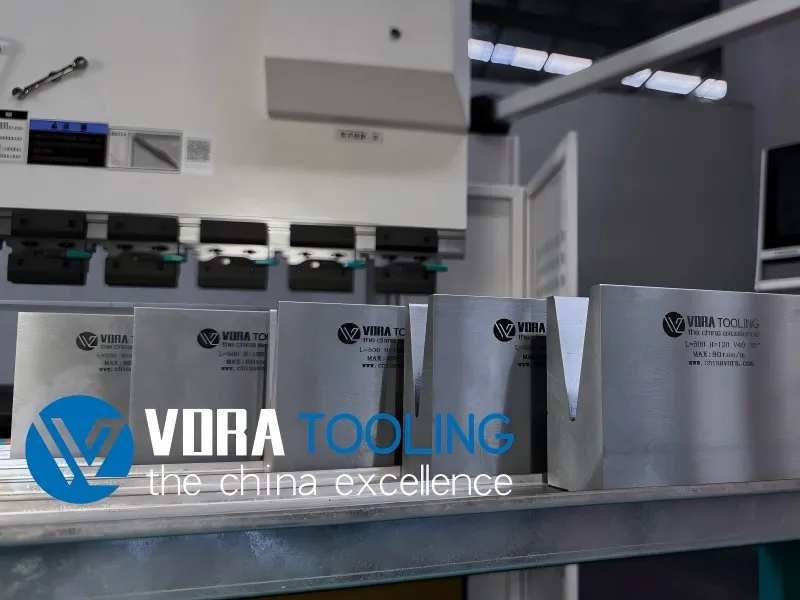
In the field of press brake operation, selecting the correct V-die opening has a critical impact on bending accuracy, tool longevity, and operational safety. While the V-opening size is often overlooked, it determines the forming quality, springback behavior, and the pressure required from the machine.
1. The Core Rule
The industry standard often uses the "8x Rule" for a preliminary calculation: the width of the lower die V-opening should be 8 times the material thickness. This rule is widely applied in many bending scenarios. However, it is only a basic guideline. The actual precise calculation needs to consider multiple interacting factors, which are reflected in the following key relationships:
Optimal V = f(T, σ, A, R, P, S) Where:
- T = Material Thickness
- σ = Material Tensile Strength
- A = Desired Bend Angle
- R = Required Inside Radius
- P = Available Press Tonnage
- S = Required Surface Quality
2. Five Core Influencing Factors
2.1 Material Characteristics
Different materials require different V-openings relative to their thickness. A V-opening that is too small will drastically increase the required tonnage, risking damage to the tooling and machine, and may cause a "sharp" bend with excessive material thinning. An opening that is too large will lead to poor angle control, excessive springback, and a large, inconsistent bend radius. Use the following as a starting reference:
(1) Mild Steel: V-opening width = 6 to 8 times material thickness
(2) Stainless Steel / Harder Materials: V-opening width = 8 to 12 times material thickness
(3) Aluminum / Softer Materials: V-opening width = 5 to 7 times material thickness
2.2 Determining the Required Inside Bend Radius
(1) Accepting the Naturally Formed Radius: In air bending, if there is no strict requirement for the Inside Radius (IR), you can follow the formula IR ≈ V/6 and accept a fluctuation of ±15%. In this case, the V-opening selection primarily serves tonnage and bend angle requirements.
(2) Inside Radius Must Match a Specified Value: When the drawing explicitly specifies an IR, the selection logic must be reversed. For example, if the required IR = 3mm:
①Lock the Upper Punch: Prioritize an upper punch tip radius of R3 or R2.5.
②Reverse-Calculate the Lower Die: The V-opening should satisfy V = (6~8) × IR, meaning choose a lower die in the V18-V24 range. This ensures sufficient material flow space, avoiding side scoring or angle abnormalities caused by compression.
2.3 Calculating Required Tonnage and Checking Equipment Limits
(1) Tonnage Formula for Air Bending:
P = (650 × S² × L) / (1000 × V)
S (Sheet Thickness): The thickness of the metal sheet to be bent, measured in millimeters.
L (Sheet Length): The total length of the bend edge, in millimeters.
V (Die Opening): Typically 6-10 times the sheet thickness (6x is common for CNC press brakes, 8x for standard machines).
(2) Safe Application Rules:
①80% Rule: The actual used tonnage should not exceed 80% of the machine's rated tonnage.
②Equipment Age Factor: For older machines (>10 years), an additional 15% safety margin is required.
③Multi-Operation Distribution: Consider thermal machine degradation during continuous bending. Increase the safety factor by 10% in summer.
2.4 Considering Specific Bend and Part Geometry
(1) Controlling Flange Height:
①General Rule: Minimum flange height H_min > √(V/2) + T. For example, when V=16mm, H_min should be greater than √8 + T ≈ 2.8mm + T.
②Short Flange Bending (H close to the limit): A small-angle die (30°/45°) must be used to avoid interference between the upper punch and the die shoulders. At the same time, ensure the material does not over-stretch or crack during bending, especially for thick or high-strength materials. Increase the bend radius appropriately. When H is smaller than the minimum flange height, consider using a coining process or modifying the part design to meet the forming requirements. In actual processing, parameters should be dynamically adjusted based on machine accuracy and tool wear to ensure bend angle and dimensional stability.
(2) Special Profile Shapes:
①Edge with Pre-punched Holes/Notches: Determine if the die shoulder will press onto the hole edge, causing deformation.
②Non-Right Angle Bends: Require V-dies with corresponding angles (e.g., 120°, 135°).
2.5 Selecting the Die Profile Based on Customer Needs
(1) Selection Based on Production Mode and Batch Size:
| Production Scenario | Optimal Die Profile Selection | Core Logic & ROI |
|---|---|---|
| High-volume standardized production (e.g., automotive parts) | Solid carbide lower die | Unit price is 5-8 times that of standard tooling, but lifespan can exceed 500,000 cycles. Lowest cost per part, ideal for long-term fixed products. |
| Multi-variety, small-batch flexible production (e.g., electrical cabinets) | Modular segmented standard lower die | Flexible combination to adapt to various sizes. Minimal need for new tooling after initial investment. The foundation for quick changeovers. |
| R&D / Prototyping center | Universal adjustable lower die + a few standard segments | Maximum flexibility to handle infinite product designs. Sacrifices some precision and speed for unparalleled adaptability. |
(2) Selection Based on Quality and Automation Level Requirements:
①Pursuing a "Zero-Scratches" Appearance: Choose precision-polished lower dies coated with Titanium Nitride (TiN) or Diamond-Like Carbon (DLC) to ensure a flawless product surface.
②Compatibility with Automated Production: The tooling must be standardized and lightweight to integrate seamlessly with robots and Automatic Tool Changer (AMS) systems.
3. Conclusion
Selecting the correct lower die V-opening is far more than a simple numerical match. It is a delicate balancing act that integrates material science, mechanical principles, and practical experience. As we have seen, every factor—from material thickness and bend angle to machine capacity and production batch size—plays a key role in this decision.
In the world of sheet metal bending, details determine success. A correct V-die selection not only significantly reduces scrap rates and extends tool life but also earns you the dual advantage of precision and efficiency in a competitive market.
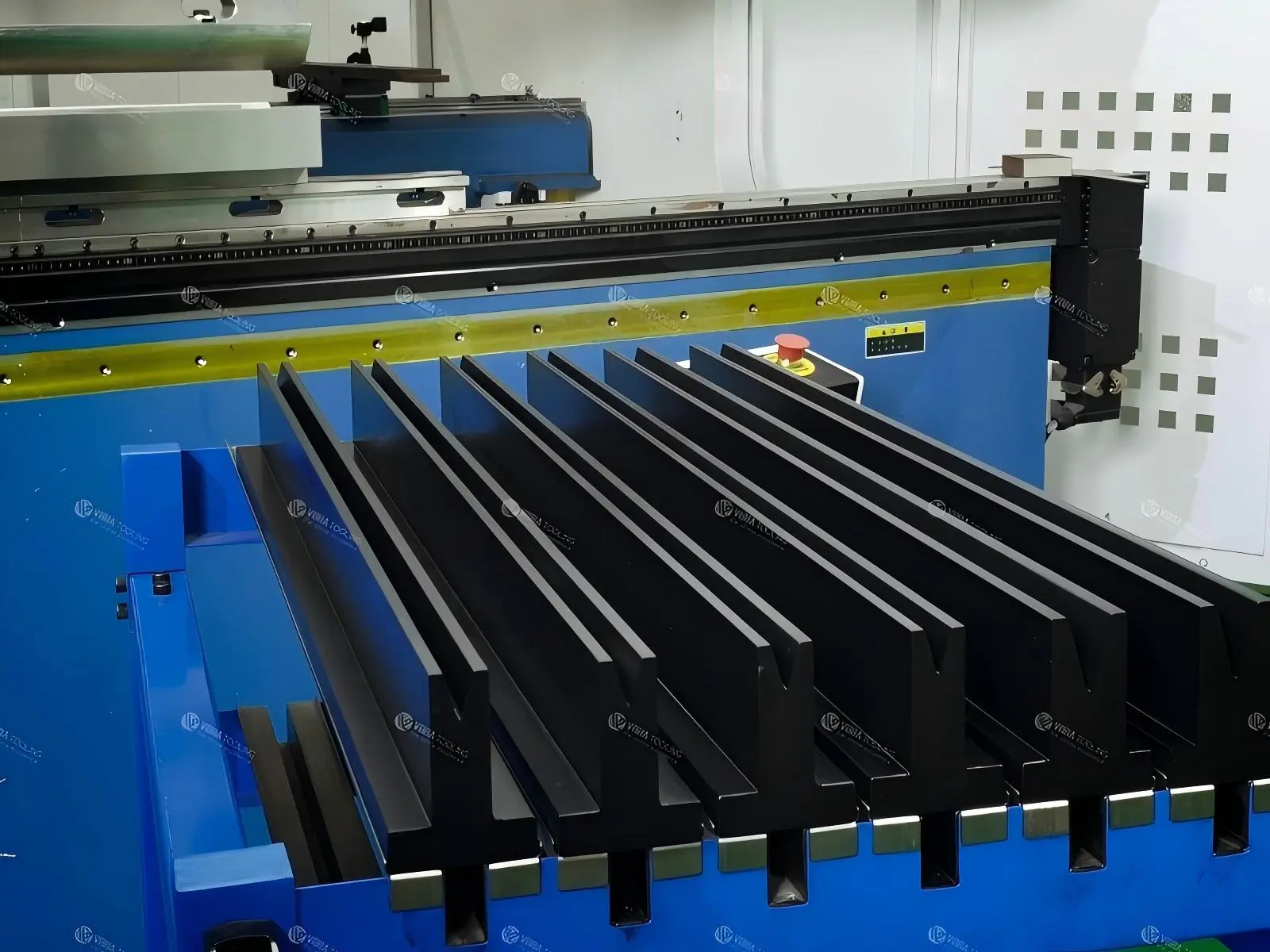
In the field of press brake operation, selecting the correct V-die opening has a critical impact on bending accuracy, tool longevity, and operational safety. While the V-opening size is often overlooked, it determines the forming quality, springback behavior, and the pressure required from the machine.
1. The Core Rule
The industry standard often uses the "8x Rule" for a preliminary calculation: the width of the lower die V-opening should be 8 times the material thickness. This rule is widely applied in many bending scenarios. However, it is only a basic guideline. The actual precise calculation needs to consider multiple interacting factors, which are reflected in the following key relationships:
Optimal V = f(T, σ, A, R, P, S) Where:
- T = Material Thickness
- σ = Material Tensile Strength
- A = Desired Bend Angle
- R = Required Inside Radius
- P = Available Press Tonnage
- S = Required Surface Quality
2. Five Core Influencing Factors
2.1 Material Characteristics
Different materials require different V-openings relative to their thickness. A V-opening that is too small will drastically increase the required tonnage, risking damage to the tooling and machine, and may cause a "sharp" bend with excessive material thinning. An opening that is too large will lead to poor angle control, excessive springback, and a large, inconsistent bend radius. Use the following as a starting reference:
(1) Mild Steel: V-opening width = 6 to 8 times material thickness
(2) Stainless Steel / Harder Materials: V-opening width = 8 to 12 times material thickness
(3) Aluminum / Softer Materials: V-opening width = 5 to 7 times material thickness
2.2 Determining the Required Inside Bend Radius
(1) Accepting the Naturally Formed Radius: In air bending, if there is no strict requirement for the Inside Radius (IR), you can follow the formula IR ≈ V/6 and accept a fluctuation of ±15%. In this case, the V-opening selection primarily serves tonnage and bend angle requirements.
(2) Inside Radius Must Match a Specified Value: When the drawing explicitly specifies an IR, the selection logic must be reversed. For example, if the required IR = 3mm:
①Lock the Upper Punch: Prioritize an upper punch tip radius of R3 or R2.5.
②Reverse-Calculate the Lower Die: The V-opening should satisfy V = (6~8) × IR, meaning choose a lower die in the V18-V24 range. This ensures sufficient material flow space, avoiding side scoring or angle abnormalities caused by compression.
2.3 Calculating Required Tonnage and Checking Equipment Limits
(1) Tonnage Formula for Air Bending:
P = (650 × S² × L) / (1000 × V)
S (Sheet Thickness): The thickness of the metal sheet to be bent, measured in millimeters.
L (Sheet Length): The total length of the bend edge, in millimeters.
V (Die Opening): Typically 6-10 times the sheet thickness (6x is common for CNC press brakes, 8x for standard machines).
(2) Safe Application Rules:
①80% Rule: The actual used tonnage should not exceed 80% of the machine's rated tonnage.
②Equipment Age Factor: For older machines (>10 years), an additional 15% safety margin is required.
③Multi-Operation Distribution: Consider thermal machine degradation during continuous bending. Increase the safety factor by 10% in summer.
2.4 Considering Specific Bend and Part Geometry
(1) Controlling Flange Height:
①General Rule: Minimum flange height H_min > √(V/2) + T. For example, when V=16mm, H_min should be greater than √8 + T ≈ 2.8mm + T.
②Short Flange Bending (H close to the limit): A small-angle die (30°/45°) must be used to avoid interference between the upper punch and the die shoulders. At the same time, ensure the material does not over-stretch or crack during bending, especially for thick or high-strength materials. Increase the bend radius appropriately. When H is smaller than the minimum flange height, consider using a coining process or modifying the part design to meet the forming requirements. In actual processing, parameters should be dynamically adjusted based on machine accuracy and tool wear to ensure bend angle and dimensional stability.
(2) Special Profile Shapes:
①Edge with Pre-punched Holes/Notches: Determine if the die shoulder will press onto the hole edge, causing deformation.
②Non-Right Angle Bends: Require V-dies with corresponding angles (e.g., 120°, 135°).
2.5 Selecting the Die Profile Based on Customer Needs
(1) Selection Based on Production Mode and Batch Size:
| Production Scenario | Optimal Die Profile Selection | Core Logic & ROI |
|---|---|---|
| High-volume standardized production (e.g., automotive parts) | Solid carbide lower die | Unit price is 5-8 times that of standard tooling, but lifespan can exceed 500,000 cycles. Lowest cost per part, ideal for long-term fixed products. |
| Multi-variety, small-batch flexible production (e.g., electrical cabinets) | Modular segmented standard lower die | Flexible combination to adapt to various sizes. Minimal need for new tooling after initial investment. The foundation for quick changeovers. |
| R&D / Prototyping center | Universal adjustable lower die + a few standard segments | Maximum flexibility to handle infinite product designs. Sacrifices some precision and speed for unparalleled adaptability. |
(2) Selection Based on Quality and Automation Level Requirements:
①Pursuing a "Zero-Scratches" Appearance: Choose precision-polished lower dies coated with Titanium Nitride (TiN) or Diamond-Like Carbon (DLC) to ensure a flawless product surface.
②Compatibility with Automated Production: The tooling must be standardized and lightweight to integrate seamlessly with robots and Automatic Tool Changer (AMS) systems.
3. Conclusion
Selecting the correct lower die V-opening is far more than a simple numerical match. It is a delicate balancing act that integrates material science, mechanical principles, and practical experience. As we have seen, every factor—from material thickness and bend angle to machine capacity and production batch size—plays a key role in this decision.
In the world of sheet metal bending, details determine success. A correct V-die selection not only significantly reduces scrap rates and extends tool life but also earns you the dual advantage of precision and efficiency in a competitive market.
Recent Posts
Stay tuned for more updates

Need to reach us?
Leaders in industrial manufacturing & technology since 1992.