SEARCH WHAT YOU WANT

2026-04-21
Bending Auxiliary Tools
1. Laser Alignment Gauge
1.1 Definition
A Laser Alignment Gauge is a tool used to assist in positioning material on a press brake. It projects a high-brightness laser line to visually indicate the bending line on the sheet metal, effectively improving bending accuracy and efficiency.
2.2 Basic Components
(1) Laser Emitter Head
(2) High-Strength Magnetic Base
(3) Universal Adjustment Bracket
(4) Control Switch
(5) Rechargeable Battery System
3. 3Advantages
(1) Precise Positioning: The projected laser reference line provides a direct visual guide for the sheet metal bending location, reducing errors.
(2) Increased Production Efficiency: Significantly reduces setup time per workpiece.
(3) Strong Adaptability and High Compatibility: The installation or placement can be flexibly adjusted according to the press brake model and workpiece dimensions, adapting to various bending scenarios.
4.4 Usage Method
2. Magnetic Angle Finder
1.1 Definition
A Magnetic Angle Finder is an auxiliary bending tool capable of measuring angles and positioning.
2.2 Structure
Magnetic Base and Angle Measurement Scale/Protractor.
3. 3Advantages
(1) Accurate Angle Measurement: Meets various angle requirements.
(2) Magnetic Base for Convenience: Allows for quick and easy attachment, saving working time.
(3) Improves Bending Quality: Reduces errors.
4. 4Usage Method
3. Vernier Caliper
1.1 Definition
A Vernier Caliper is a measuring instrument specifically used in sheet metal bending fabrication.
2.2 Structure
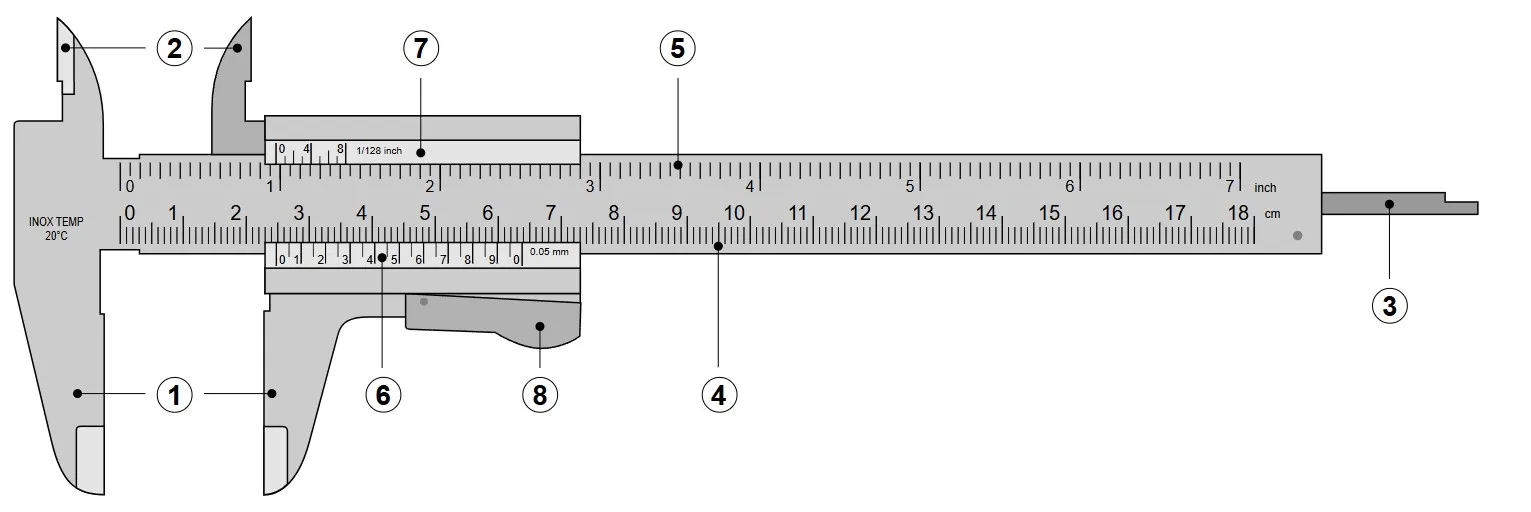
(1) External Measuring Jaws: For measuring length and external diameter.
(2) Internal Measuring Jaws: For measuring internal diameter.
(3) Depth Gauge: For measuring depth.
(4) Main Scale (cm)
(5) Main Scale (inches)
(6) Vernier Scale (cm)
(7) Vernier Scale (inches)
(8) Locking Screw: Located on the vernier scale to lock it in place.
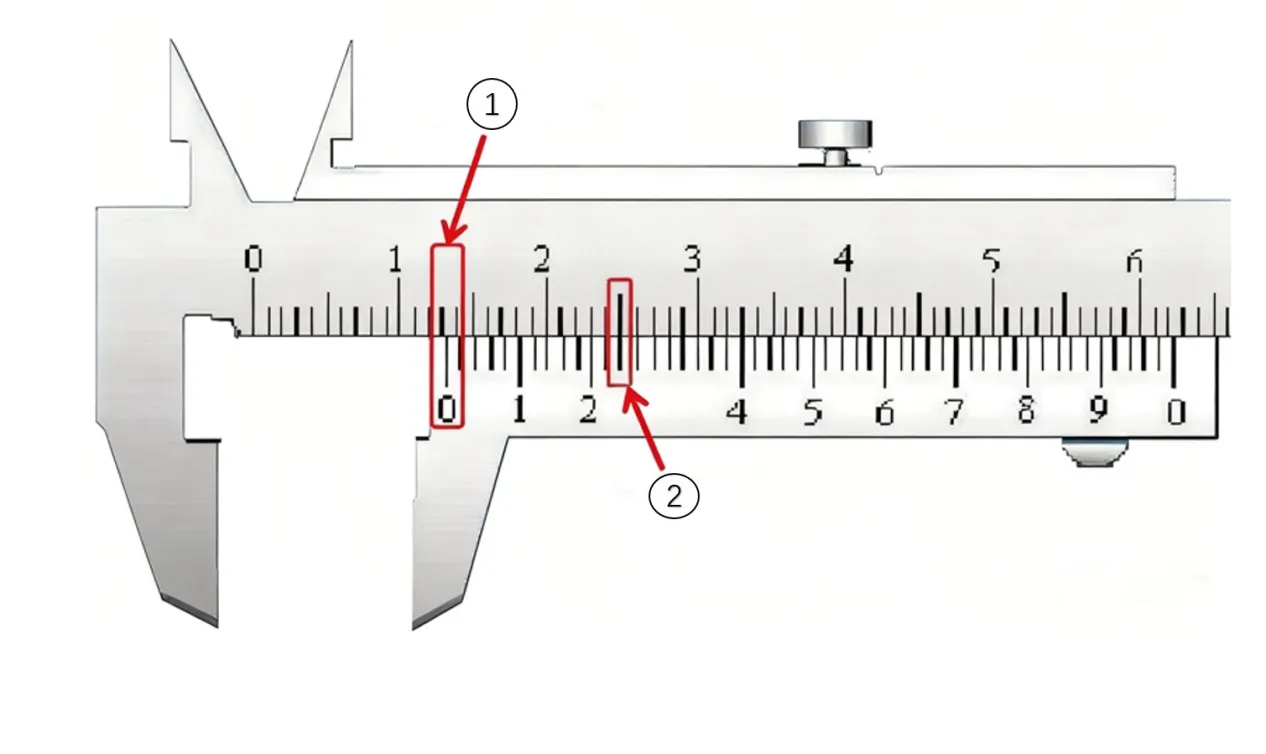
3.3 Reading Method (Example using a caliper with 0.02mm accuracy)
(1) Read the whole millimeters from the main scale aligned with the ['0'] mark on the vernier scale: In the figure, the vernier ['0'] is between main scale ['13'] and ['14'], slightly to the left, so read ['13'] mm.
(2) Identify which line on the vernier scale aligns perfectly with a line on the main scale and calculate the value: In the figure, the 12th line on the vernier aligns, so 0.02 * 12 = ['0.24'] mm.
(3) Total Measurement = Main scale reading + Vernier scale reading: ['13'] + ['0.24'] = ['13.24'] mm.
4. Universal Bevel Protractor
1.1 Definition
A tool used for measuring angles, which can be used in conjunction with a ruler and a square.
2.2 Structure
(1) Stock / Fixed Base
(2) Locking Nut / Clamp
(3) Vernier Scale (for angles)
(4) Main Scale / Protractor Body (Degrees)
(5) Blade Clamp
(6) Square Blade / 90° Attachment
(7) Ruler / Blade
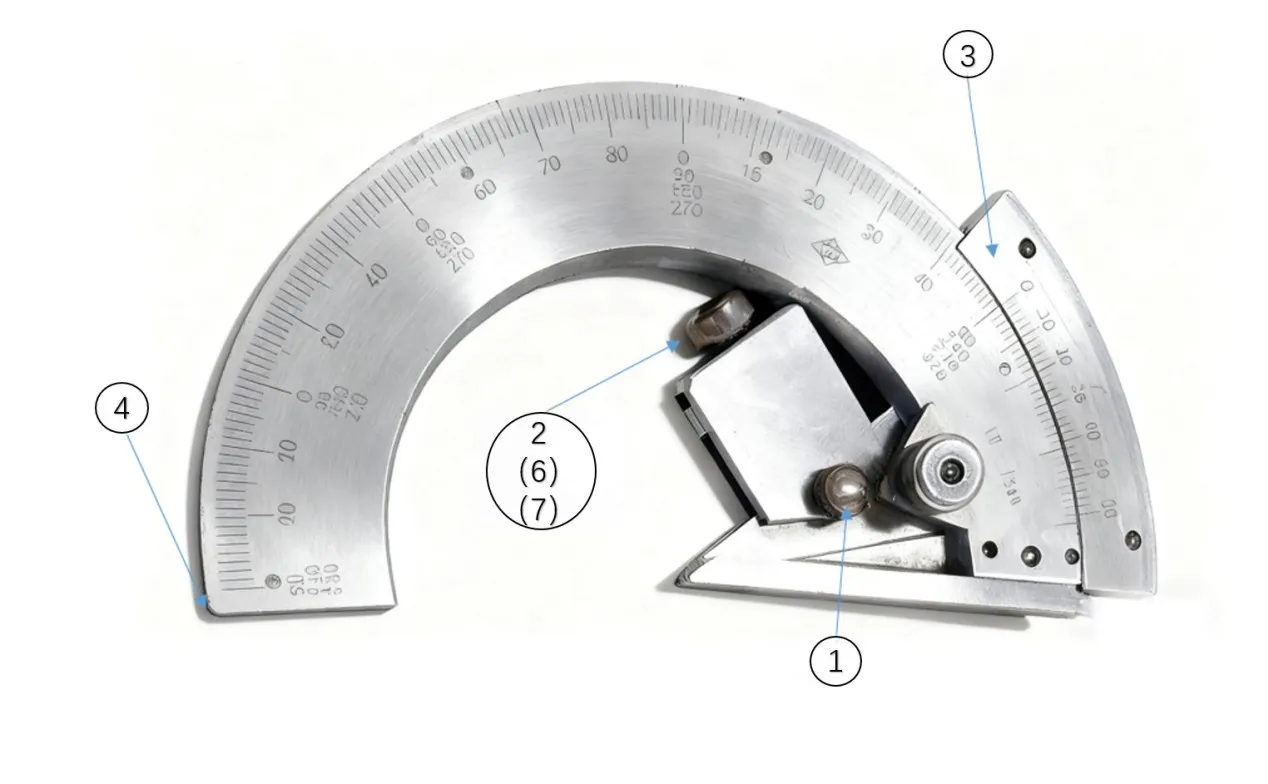
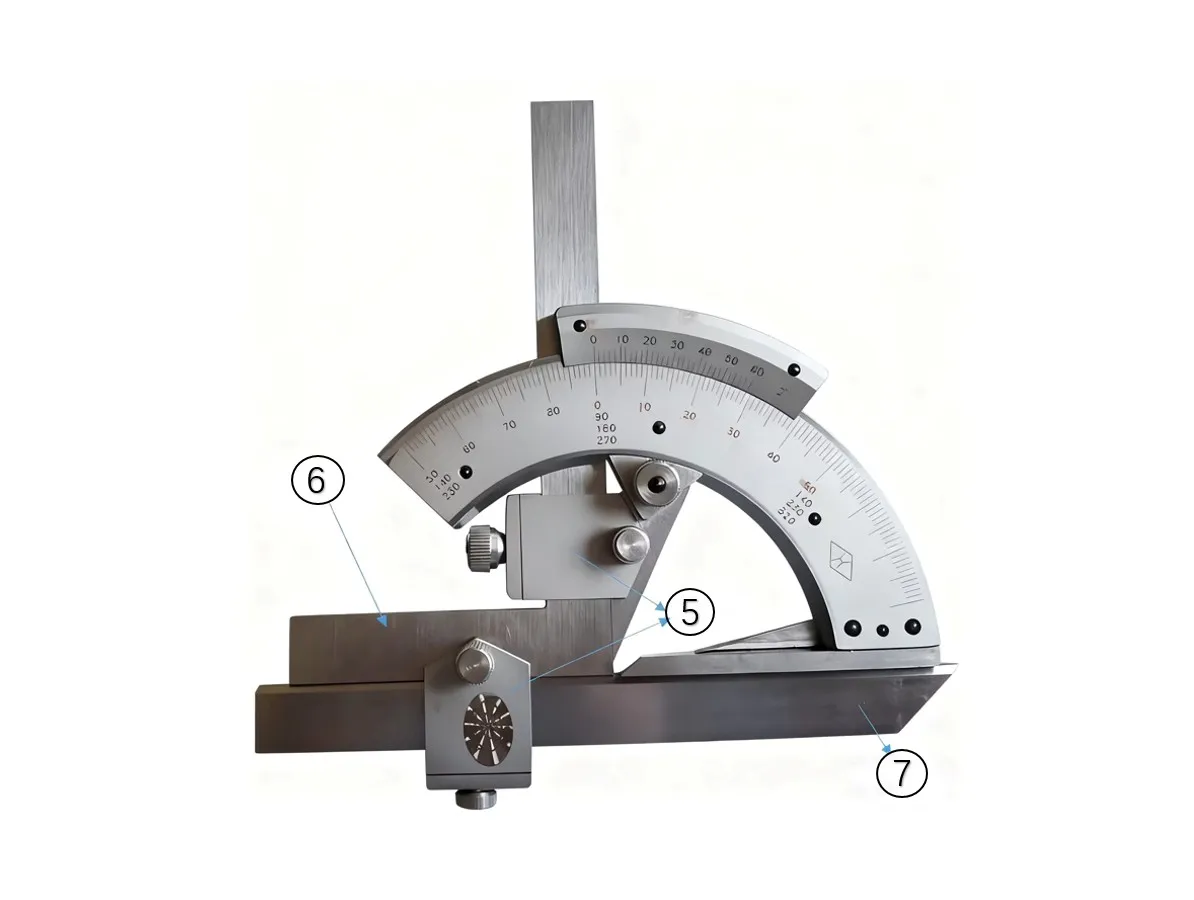
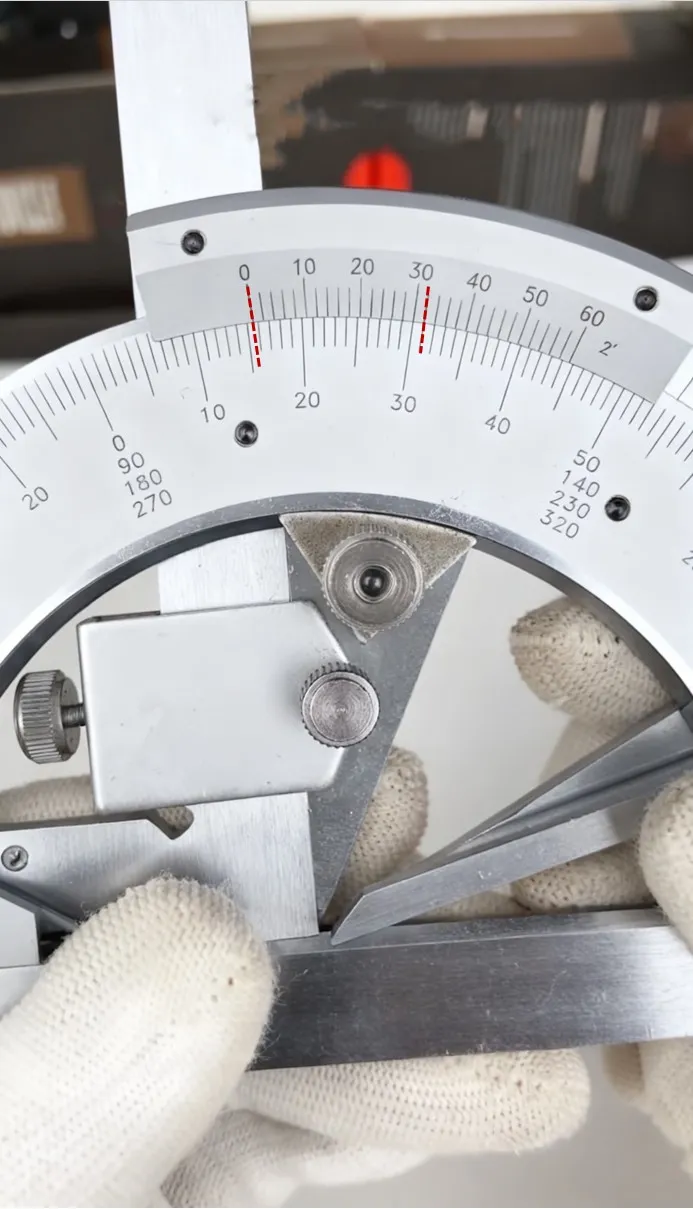
3.3 Reading (Example for a protractor with 2-minute accuracy)
(1) Read the whole degrees from the main scale where the vernier ['0'] mark aligns: In the figure, it is between ['15'] and ['16'] degrees, so the integer part is ['15']°.
(2) Find the line on the vernier scale that aligns perfectly with a line on the main scale. With an accuracy of 2 minutes, this corresponds to 32 minutes.
(3) Total Angle = 15° 32'
1. Laser Alignment Gauge
1.1 Definition
A Laser Alignment Gauge is a tool used to assist in positioning material on a press brake. It projects a high-brightness laser line to visually indicate the bending line on the sheet metal, effectively improving bending accuracy and efficiency.
2.2 Basic Components
(1) Laser Emitter Head
(2) High-Strength Magnetic Base
(3) Universal Adjustment Bracket
(4) Control Switch
(5) Rechargeable Battery System
3. 3Advantages
(1) Precise Positioning: The projected laser reference line provides a direct visual guide for the sheet metal bending location, reducing errors.
(2) Increased Production Efficiency: Significantly reduces setup time per workpiece.
(3) Strong Adaptability and High Compatibility: The installation or placement can be flexibly adjusted according to the press brake model and workpiece dimensions, adapting to various bending scenarios.
4.4 Usage Method
2. Magnetic Angle Finder
1.1 Definition
A Magnetic Angle Finder is an auxiliary bending tool capable of measuring angles and positioning.
2.2 Structure
Magnetic Base and Angle Measurement Scale/Protractor.
3. 3Advantages
(1) Accurate Angle Measurement: Meets various angle requirements.
(2) Magnetic Base for Convenience: Allows for quick and easy attachment, saving working time.
(3) Improves Bending Quality: Reduces errors.
4. 4Usage Method
3. Vernier Caliper
1.1 Definition
A Vernier Caliper is a measuring instrument specifically used in sheet metal bending fabrication.
2.2 Structure
(1) External Measuring Jaws: For measuring length and external diameter.
(2) Internal Measuring Jaws: For measuring internal diameter.
(3) Depth Gauge: For measuring depth.
(4) Main Scale (cm)
(5) Main Scale (inches)
(6) Vernier Scale (cm)
(7) Vernier Scale (inches)
(8) Locking Screw: Located on the vernier scale to lock it in place.
3.3 Reading Method (Example using a caliper with 0.02mm accuracy)
(1) Read the whole millimeters from the main scale aligned with the ['0'] mark on the vernier scale: In the figure, the vernier ['0'] is between main scale ['13'] and ['14'], slightly to the left, so read ['13'] mm.
(2) Identify which line on the vernier scale aligns perfectly with a line on the main scale and calculate the value: In the figure, the 12th line on the vernier aligns, so 0.02 * 12 = ['0.24'] mm.
(3) Total Measurement = Main scale reading + Vernier scale reading: ['13'] + ['0.24'] = ['13.24'] mm.
4. Universal Bevel Protractor
1.1 Definition
A tool used for measuring angles, which can be used in conjunction with a ruler and a square.
2.2 Structure
(1) Stock / Fixed Base
(2) Locking Nut / Clamp
(3) Vernier Scale (for angles)
(4) Main Scale / Protractor Body (Degrees)
(5) Blade Clamp
(6) Square Blade / 90° Attachment
(7) Ruler / Blade
3.3 Reading (Example for a protractor with 2-minute accuracy)
(1) Read the whole degrees from the main scale where the vernier ['0'] mark aligns: In the figure, it is between ['15'] and ['16'] degrees, so the integer part is ['15']°.
(2) Find the line on the vernier scale that aligns perfectly with a line on the main scale. With an accuracy of 2 minutes, this corresponds to 32 minutes.
(3) Total Angle = 15° 32'
Next: Fundamentals of Bending
Recent Posts
Stay tuned for more updates

Need to reach us?
Leaders in industrial manufacturing & technology since 1992.